


“I’ll Always Be in Love With You”
Composed by Sam H. Stept; arranged by Fletcher Henderson.
Recorded by Bunny Berigan and His Orchestra for Thesaurus Transcription Service on June 27, 1938 in New York.
Bunny Berigan, first and solo trumpet, directing: Steve Lipkins and Irving Goodman, trumpets; Nat Lobovsky and Ray Conniff, trombones; Mike Doty first alto saxophone; Joe Dixon, alto saxophone and clarinet; Clyde Rounds and Georgie Auld, tenor saxophones; Joe Bushkin, piano; Dick Wharton, guitar; Hank Wayland, bass; Johnny Blowers, drums.
The story:


The next night, Bunny’s band was broadcast over WABC–New York, probably from somewhere in Pennsylvania. Bunny’s drummer at the time, Johnny Blowers, kept a diary of places he played with the Berigan band, but sometimes did not place a date with the location. Here are some of the venues the band played for the period June 17 to June 25: Tyrone, Pennsylvania (west of State College); Hershey, Pennsylvania, at Starlight Ballroom, Hershey Park, (15 miles east of Harrisburg); Shamokin, Pennsylvania, at Edgewood Park; on June 23, at the Crystal Ballroom, Cumberland, Maryland; Ithaca, New York, at Cornell University; Middletown State Armory, Kingston, New York, on Saturday, June 25; Greenwich, Connecticut. At some point in this eight-day span, a mix-up occurred involving a date at Old Orchard Beach, Maine.


The fact is that in the summer of 1938, the Berigan band was very successful. Its management (MCA, Bunny’s booking agent, and Arthur Michaud, his personal manager) however were by then focusing most of their attention elsewhere, primarily on the development of Gene Krupa’s new band. Engagements that otherwise might have gone to Berigan now were going to Krupa. As a result, there seemed to be no real plan as to how to achieve maximum financial return for the Berigan band on the road.

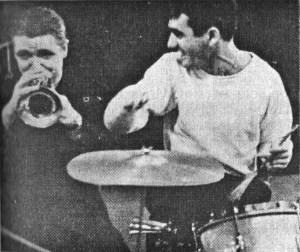
Also, logistical slip-ups started to occur. These snafus have long been attributed to Bunny’s lackadaisical attitude about business matters. However, he was paying others very well to attend to these important issues, as other bandleaders did, and had every reason to expect that they would be handled properly. Increasingly, they were not being handled properly, and Bunny’s normally sanguine attitude sometimes turned edgy. He, not MCA or Michaud, had to pay the band while they enjoyed an unplanned off day, rode amusement rides, and played games at Old Orchard Beach.
On June 27, the Berigan band again visited the RCA Victor studios on East 24th Street in Manhattan, but this time he and his musicians were scheduled to make recordings for RCA’s Thesaurus radio transcription service. The sixteen inch 33 1/3 rpm discs on which Thesaurus marketed these recordings were leased or sold to radio stations under the generic name “Rhythm Makers Orchestra” or “The Rhythm Makers.” No actual identification of the many bands that made Thesaurus transcriptions was ever done.
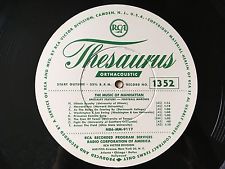


Of equal or greater interest however are the tunes Berigan recorded for Thesaurus but did not record for Victor. “I’ll Always Be in Love With You” is one such tune. The arrangement the Berigan band used on it was written by Fletcher Henderson, and is the same arrangement he recorded for Victor with his own band on April 9, 1936. Solos in this Berigan version are by Georgie Auld on tenor saxophone, Joe Dixon on clarinet, an ultrawarm Berigan on trumpet, Joe Bushkin on piano, and Ray Conniff on trombone.
This same arrangement was also recorded for Victor by Benny Goodman on December 15, 1938. BG by then evidently had enough power at Victor to record this tune for that label even though the Henderson disk may still have been on the market. One wonders why Bunny didn’t record this tune for Victor. He was obviously playing it months before the Goodman recording was made, and his band’s performance of it here is excellent. Victor’s executives may well have nixed any such idea in deference to the Henderson disk, but then allowed Goodman to record it probably because he sold more records than either Henderson or Berigan.


Drummer Johnny Blowers related an incident that occurred in the wake of this Thesaurus recording date that is indicative of the way Arthur Michaud handled the Berigan band’s business, and probably led directly to Blowers leaving the Berigan band. After not being paid extra for the Thesaurus recording session, Blowers went to Michaud and asked where his money was for the transcription date. “‘What transcription date?’ he said, trying to look innocent. ‘My contract states that I’m to get paid extra for recording. That transcription date was supposed to pay over $400. (Probably for the whole band.) I want my money or I’m going to report you to the union.’ The threat worked, and everybody in the band was paid for the date.” [iii]


One of the many benefits accruing to people who host blogs is that wonderfully informative communications sometimes arrive at the blog or by email quite unexpectedly. I have benefited from many of these relationships. One of them, with San Francisco trumpeter Michael Beal, has been particularly rewarding because Michael not only understands trumpet technique, he has a deep understanding of music itself. I have learned much from Michael.
The following are excerpts from Michael’s recent emails to me about Bunny Berigan’s Thesaurus recording of “I’ll Always Be in Love With You.”
“Since my teen years, I’ve always been drawn to Bunny’s playing, however my exposure to his music back then was extremely limited. In exploring Berigan’s music in fits and starts over many years, I recently stumbled across his recording of ‘I’ll Always Be in Love With You.’ I did not know any of the details about the recording, but I did hear the music, particularly Berigan’s solo, and for some reason, the music absolutely spoke to me, so much so that I transcribed it. It wasn’t until after I transcribed it that I realized the true genius within, which initially and completely escaped me – even afterwards for many days.


“As one can see from this transcription, Bunny’s sixteen bar solo isn’t technically challenging, compared to many of his others. But analysis reveals the following:
—The solo consists a total of 59 notes
—Of the 59 notes Berigan played, 51 of those notes are exclusively from the 5 note E Major pentatonic scale! (That’s 86.44 % for us stat geeks!)”
Other observations/insights by Mr. Beal:
“—This tune, using a classic 32-bar AABA format, was written as a waltz. Here it’s been updated to a 4/4 swing.
—If we assume the chord changes for this melody (as composed) are identical to those in the Fletcher Henderson arrangement, which almost assuredly they are not, we see Bunny only deviated from the chord changes twice, when he played a minor third over a dominant 7 chord – in bars 8 and 9. From an improvisational viewpoint the minor 3rd on a dominant scale is frequently done in all eras of jazz. It’s usually a ‘bluesy’ sounding note, but in these instances, Bunny utilizes them merely as passing tones.


“—Berigan’s approach to this particular solo is seemingly simplistic, yet it reveals his musical genius. His ability to limit his note selection, spanning the 8 bar bridge and final eight bar ‘A’ section, to a simple 5 note scale (covering less than 2 octaves) is remarkable.
But it’s his melodic structuring and phrasing of these notes that’s astonishing – especially given the context of the this recording, which was a one-take performance for a radio transcription done under somewhat hurried circumstances.If you listen to jazz soloists, even today, depending on a variety of factors, very often master soloists play in 2, 4 or 8 bar phrases. These phrase usually correspond to the structure of the tune. In this case the song has the classic AABA, 32-bar format. Listen to the clarinetist Joe Dixon’s solo. He’s playing in two and four bar phrases. It’s a fine solo, but it’s also an illustration of phrasing in the conventional manner. The same type of phrasing is used by the other soloists on this recording.”


“Berigan’s solo begins at the 8-bar bridge. Now listen (at bar 6) to the ‘turn-around’ line Bunny plays transitioning from the bridge (beginning on the 4th beat of bar 6 of his solo, continuing through bar 9) to the beginning of the final 8 bars (the A part of the tune) of his solo. Here Berigan utilizes the final three measures of the bridge to logically segue into the final eight bars, which end his solo lyrically.


Beginning in bars 13, 14 and the first two beats of bar 15, Bunny again utilizes this same E major pentatonic scale, by inverting it. Instead of starting on the root (E) of the scale, he starts on the 4th (B natural) – then works his way up an octave and back down again. He then concludes his solo playing an E pentatonic ‘chord’ of sorts.
Berigan’s subtle utilization of this singular, simple scale may be beyond comparison, context of era not withstanding. This solo, which is very musical, has a logical beginning, middle and ending.I suspect if you had 100 people listen to this solo and comment on it, no one say, ‘well, he mostly played the same 5 notes over and over.’
I knew for years that Bunny utilized the D pentatonic scale in his opening cadenza of ‘I Can’t Get Started,’ but also knew that I’d never heard a soloist before him do so.


Bunny’s long departed soul still lives in his music. Whatever demons tormented him to an early end, certainly didn’t encroach on this example of his genius. Here, he simply is making a subtle mockery of how easy it was for him to improvise!”
Michael and I discussed where or how Berigan might have learned about the pentatonic scale. My informed speculation is that he learned about it in either the Paul Whiteman orchestra, or while playing at CBS. In both instances, Bunny was working with many conservatory trained musicians who would have known about the pentatonic scale. I will also suggest that after Berigan came to understand the pentatonic scale, he simply stored away that knowledge in his subconscious musical mind. It came out in his improvisations from time to time, and I am fairly certain that he did not consciously calculate beforehand how he could use that knowledge in a given solo. It just would come out at seemingly appropriate times in strikingly creative ways.
One final observation: In addition to the solo Berigan played in this performance, he also played the first trumpet part. It is clear to me from the sound of his solo trumpet relative to the rest of the instruments in his band that he was playing that solo from the trumpet section, not into a microphone in front of the band. This makes sense because of his need to play the lead trumpet part while sitting next to the other two trumpeters, so they could hear him and follow his lead.
[i] Cited in the White materials: June 16, 1938.
[ii] Back Beats and Rim Shots …the Johnny Blowers Story, by Warren W. Vache’ (1997) 40.
[iii] Blowers, ibid.
I thank Loren Schoenberg for recently unearthing the montage of Bunny Berigan presented in this post. This montage was part of a feature story about Berigan and Benny Goodman that appeared in the New York Herald Tribune on July 11, 1937. At that time, MCA was providing Berigan with considerable valuable promotion in the mainstream press.
The recording used in this post was digitally remastered by Mike Zirpolo.