



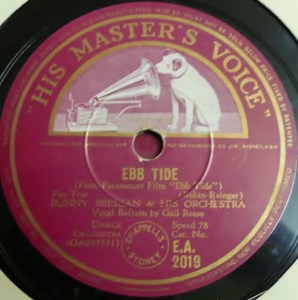
“Ebb Tide”
Composed by Leo Robin (lyric) and Ralph Rainger (music).
Arranged by Joe Lippman.
Recorded by Bunny Berigan and His Orchestra for Victor on September 3, 1937 in New York.
Bunny Berigan, first and solo trumpet, directing: Steve Lipkins and Irving Goodman, trumpets; Sonny Lee and Al George, trombones; Mike Doty and Joe Dixon, alto saxophones; (Dixon also plays the lead clarinet part); Clyde Rounds and Georgie Auld, tenor saxophones; Joe Lippman, piano; Tommy Morgan, guitar; Hank Wayland, bass; George Wettling, drums; Gail Reese, vocal.
The story:


“She was a character. She used to follow us around a lot. When we played at Valley Stream, Long Island, she was there every night—every night! Bunny’d go out in the car with her between sets and when he’d come back he’d be…spent. After he was with her he used to fold up sometimes. We lost that job on account of her. It was a beautiful job out there. The boss finally told Bunny: ‘Look, either she goes or the band goes.’ Bunny said, ‘Well, then the band goes!’ Oh my God! Everybody was real unhappy with Bunny. The job was so good, and we had to go out on one-nighters and crap like that. He wasn’t thinking of the guys in the band that time. But we wouldn’t fool with him. He could be thick-headed at times too. We were frustrated because there were no bookings. We had to scramble around.” (1)


The facts are that the Berigan band played exactly seven weeks at Pavillon Royal, not just the six that were originally scheduled. This suggests that Bunny’s management was possibly doing the Pavillon Royal’s management a favor by extending what had apparently been a very profitable engagement for the venue for another week. Anyone in the band business should have known that a location job like that never allowed a band to break even, much less make a profit. (The countervailing consideration was that Pavillon Royal had a network radio wire that broadcast the Berigan band’s music nationwide, thus providing a valuable promotional assist for the band.) (2)
Since the Berigan band was tied to the New York area because of their ongoing commitment to the successful Mutual radio network show, Fun in Swingtime, Bunny’s management had to find the most profitable employment possible for the band, but within an hour’s drive of New York, for as long as his commitment to the radio program continued. It is possible that there were negotiations between Bunny’s management and the Pavillon Royal to extend the Berigan band’s stay even longer, but that these came to nothing, and the Berigan band then left after the one-week extension.


MCA was still in the process of trying to book a highly lucrative tour of one-nighters and week-long theater engagements for the Berigan band, but again, this tour could not commence until Bunny could leave the Fun in Swingtime show. It is likely that MCA and/or Arthur Michaud, Berigan’s personal manager, would have tried to free Berigan from Fun in Swingtime at this juncture, but the radio show’s management refused to let Bunny go because his band’s presence on the show was helping its popularity. (The Berigan band was playing four or five selections on the show each week.)
So the waiting game continued. Bunny and his band could not hit the road to make good money because of their ongoing commitment to the Fun in Swingtime radio show. Nevertheless, the Berigan band did not scramble around for lack of bookings, as Tommy Morgan said. Immediately after departing the Pavillon Royal, Bunny’s band went to another location in or near New York (not specified in the White materials), and played there for a few days. They broadcast from this location over WABC on August 31.(3)
The real challenge Bunny’s management had then was to fill in the band’s schedule with good jobs in and around New York while they completed their Fun in Swingtime contract. As subsequent events would eventually make clear, Bunny could not leave the Fun in Swingtime show until mid-October, at the earliest. So, in early September, MCA announced that the Berigan band would open a two-week engagement at the Meadowbrook in Cedar Grove, New Jersey, on September 7.
Between September 1 and the Meadowbrook opening, the Berigan band remained very busy. On September 3, they made some more records at Victor’s 24th Street studio in Manhattan.
The music:


It is easy, especially for non-trumpeters, to overlook Bunny’s first solo, which is essentially a sixteen bar melodic exposition/paraphrase. But when a knowledgeable trumpeter listens, much more is apparent. San Francisco trumpeter Michael Beal has graciously taken note of what he heard when his listened to this Berigan solo, and shared his impressions with us: “In the first 8 bars, Bunny’s playing using a cup-mute is relaxed and free. The melody is easily recognizable as he gently embellishes it. But as he moves in to the second 8 measures of his solo, Bunny does something that’s quite dramatic for his day. He starts on the same middle B natural (on his Bb trumpet) as he did on the first eight bars, but then utilizes a half-valve glissando to move up an octave to a high B natural, then continues to navigate the melody in the upper register throughout the next 8 bars. If you examine the first 8 bars of Berigan’s solo, and compare them with the second 8 bars, you’ll see that his lines are a bit more complex an octave higher than they were in the lower register. During the second 8 bars, Bunny’s highest note is a D, which he appears to play with ease. Notice the sensitivity in his playing in those second eight bars. He is singing the melody with his trumpet.”


“Most trumpeters will agree that it is much easier to play sensitively in the lower register than in the upper register of the horn. The reason for this is that relatively little energy is utilized playing in the lower register. This allows for more control and command of the horn. Playing in the upper register requires much more energy as your body is having to produce a faster airstream to make your upper lip vibrate faster. This results in your embouchure having to manipulate this increased airflow into the cup of the mouthpiece.”
“As I mentioned previously, Berigan played the16 bar melody statement using a cup mute, which presents the player with more resistance requiring him to compensate to keep his instrument on pitch. So it’s noteworthy to understand that Bunny’s playing here, while muted and sounding so subtle and relaxed, should not misconstrued as being easy to do. This is NOT the case for most players, It’s definitely doable, but it’s definitely NOT easy.
“It is the ability of Bunny Berigan to do all of these things with apparent ease that separated him from most trumpeters of his day – and even from those of us listening to this 81 years later.”


As good as Lippman’s arrangement is, and as quintessential as Berigan’s melody exposition in the first chorus is, it is because of Bunny’s solo after the vocal that this performance will be remembered. After a brief pause, Berigan enters on the bridge of the tune, playing in the low register of the trumpet (low Eb), and then glisses lower (to a low G). His sound in this seldom explored nether region of the trumpet’s range is sumptuous and velvety: he lovingly shapes each note as a sculptor would shape the details of a fine statue. The effect is to immediately transport the listener from the realm of 1930s dance music into a warm and magical place not defined by time, space, or anything else.
Then quite unexpectedly, lightning strikes: by playing three ascending notes, (low, then middle, then high B-flats), Berigan is suddenly in the upper reaches of the trumpet’s range, and ends his solo by perfectly lip-trilling the climactic last note (a high E flat) as the band returns (with Bunny then leading the brass) to finish the performance.


After hearing this, the members of Bunny’s band no doubt looked at each other in amazement all thinking the same thought simultaneously: where did that come from?
Once again, Michael Beal provides some insights: “In 1937, what Berigan did simply could not be done by many players. Not only does Bunny ‘nail’ that high E-flat, he lip-trills it and sustains it for 10 beats and is soaring over the ensemble that enters in bar 9. The fact that he is able to trill and sustain this high E-flat as he did shows that he was playing with technique that in 1937 was other-worldly.”
(*) Ebb Tide is a 1937 American Technicolor adventure film directed by James P. Hogan and starring Oscar Homolka, Frances Farmer and Ray Milland. Much of the film is set in the South Seas and is based on the novel The Ebb-Tide by Robert Louis Stevenson and his stepson Lloyd Osbourne. It was a remake of the 1922 Paramount silent film Ebb Tide.
(1) Bunny Berigan Elusive Legend of Jazz, by Robert Dupuis: 159–160.
(2) Those interested in Bunny Berigan’s music should know that while the Berigan band was at Pavillon Royal in the summer of 1937, eight separate broadcasts from that venue were recorded. The dates of the broadcasts that were recorded are: July 13; 17; 20; 24; August 3; 10; 17; and 21. Each broadcast contained approximately nine tunes. The July 20 broadcast included a performance of “I Can’t Get Started,” this being about two weeks before Berigan recorded this tune for Victor. If anyone knows anything about these broadcast recordings, please contact me. I will do everything I can to present them to the public.
(3) White materials: August 31, 1937.
This recording was digitally remastered by Mike Zirpolo.
My thanks to trumpeter Michael Beal for taking the time to analyze Bunny Berigan’s playing on this recording, and sharing his insights with us.