


“Sobbin’ Blues”
Composed by Art Kassel and Vic Berton; arranged by Joe Lippman.
Recorded by Bunny Berigan and His Orchestra for Victor on November 22, 1938 in New York.
Bunny Berigan, trumpet, directing: Johnny Napton, first trumpet; Irving Goodman, trumpet; Ray Conniff, first trombone; Bob “Brad” Jenney, trombone; Arcuiso “Gus” Bivona, first alto saxophone and clarinet; Murray “Jumbo” Williams, alto saxophone; Georgie Auld, tenor saxophone; Clyde Rounds, tenor and baritone saxophone; Joe Bushkin, piano; Dick Wharton, guitar; Frederick “Hank” Wayland, bass; Bernard “Buddy” Rich, drums. Solos: Berigan, trumpet; Conniff, trombone; Bivona, clarinet; Auld, tenor saxophone.


The Story: The fall of 1938 was a challenging time for Bunny Berigan and his band. Due to a snafu created by Music Corporation of America (MCA), Bunny’s booking agency, his band and Gene Krupa’s were both sent to the same venue on the same night. The gig was actually Gene’s, and Bunny and his band had to scramble to get to the ballroom where they were actually scheduled to play. Unfortunately, by the time they got there, the ballroom was closed and everybody had gone home. Shortly after that, the great hurricane of 1938 blew them out of a prime two-week engagement in Boston leaving them shaken and without gigs. These two incidents were extremely costly for Berigan, and they created substantial financial difficulty for him.


Then he broke his ankle, and it was set in a plaster cast. He rebroke it when his casted foot slipped off the place where he had propped it while he was riding on the band bus. This required more painful medical treatment, and a yet longer period for healing. On gigs, Bunny had to play while seated on a tall stool.
Then a number of his sidemen, sensing Bunny’s difficulties, gave notice to him and joined other bands, seeking more security. This was the most disturbing development for Berigan. He had worked nonstop for over a year and a half to build his band’s personnel and library of music, and felt with justification that the band he led in the fall of 1938 was a great band. Fortunately, many of the best young musicians on the swing scene wanted to work with Bunny, so he was able to secure solid, talented replacements.
Berigan and his band worked their way through a series of hastily booked one night stands in October and November. Fortunately, Bunny was able to land a series of gigs at Manhattan’s Roseland Ballroom in October (with broadcasts) [*], and play a memorable battle of music at the Savoy Ballroom in Harlem with one of the upcoming young bands that played there regularly.
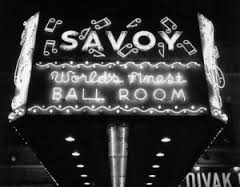

They proved to be equal to the task. As Haywood Henry, who played saxophone and clarinet for Hawkins, recalled: “There were only three bands that stole the show from us at the Savoy: Duke’s, Lionel Hampton’s and Bunny Berigan’s. Bunny took us by surprise. Usually we’d prepare in advance by rehearsing or working over one of their specialties, just to make it more exciting. We didn’t prepare for Bunny, because we thought we had him. But Buddy Rich and Georgie Auld were with him and the house came down! We had a number with a ‘Rhapsody in Blue’ ending, but when our drummer’s foot pedal broke, we sounded so horrible after Buddy Rich had got through. As for Bunny, I’ve no doubt he was the best white trumpet player. And something else— he sounded like himself!”[i]


At least one other trumpet player was there to watch the action that night. Dick Wharton, Berigan’s guitarist, remembered: “I recall Harry James, apparently on an off night, coming to the Savoy and standing only a few feet in front of the bandstand to hear Bunny and the band. He stood there set after set.”[ii]
Personnel changes continued to occur in the Berigan band. Alto saxophonist Murray “Jumbo” Williams replaced Milton Schatz, who wanted to get into studio work in New York; and Bob “Brad” Jenney, younger brother of trombone virtuoso Jack Jenney, replaced Andy Russo, who returned to studio work in New York. Pianist Joe Bushkin, who like everyone else in the band was exhausted from the endless one-night stands, took a job in New York with Pee Wee Russell. Unlike many of the other musicians in the Berigan band, he was a native New Yorker, and had a Local 802 card that allowed him to work where he pleased in New York City. It is unclear who replaced Bushkin on piano in the Berigan band. The White materials suggest that Joe Lippman returned to play piano in the band, but I doubt this. He was by this time a very successful arranger, and was contributing scores to a number of bandleaders in addition to Berigan. That kept him very busy, and it allowed him to remain in New York. In fact, at that very moment he was working on a special arranging project for Berigan that undoubtedly occupied much of his time.


On Saturday November 19th, Bunny appeared again on the Saturday Night Swing Club. Also on the program was Lee Wiley. He played “I Can’t Get Started” with the CBS band, and then led a contingent of nine musicians from his band through Joe Lippman’s new arrangement of Bix Beiderbecke’s composition “In a Mist.” Lippman explained Bunny’s thinking behind this experiment: “We were always looking for something different to record and Bunny had the devil of a time selling the idea of doing a batch of tunes associated with Bix Beiderbecke to the powers-that-be at Victor. So we introduced ‘In a Mist’ on the CBS Saturday Night Swing Club program to show what could be done. I guess the main idea was to have a little band within the big band, which was quite popular then, and we felt it was successful.” (This appears to be the last time Bunny guested on the Saturday Night Swing Club. This show, which he had a major part in starting in June 1936, was taken off the air in mid-1939).[iii] After appearing on the Swing Club, Bunny gathered the rest of his musicians and played a dance date that same night at Hotel St. George in Brooklyn.


The Music: “Sobbin’ Blues” was hardly a current pop tune in 1938. Bunny undoubtedly was familiar with the recording of this Art Kassel–Vic Berton tune made by the New Orleans Rhythm Kings in the early 1920s. He very likely told Joe Lippman to do a straight-ahead swing arrangement on it with lots of room for jazz solos, and the result is what is heard in this splendid recording.


The Berigan band is tight in this performance. Bunny’s solo in the first chorus on Harmon-muted trumpet sounds very good. When he returns with an open horn, we hear the glorious burnished sound for which he is renowned. Ray Conniff follows with a fluid and swinging trombone solo. Then Gus Bivona (who also plays the first alto saxophone part in this arrangement), takes his turn on clarinet. It is clear from his sound here that Bunny had had the same talk with him that he had had with Joe Dixon about adjusting his clarinet mouthpiece to get a brighter sound. Bivona definitely did not sound this way in his many recordings with the Hudson-De Lange band of which he was a member before he joined Berigan. Georgie Auld is up next with a flowing, cogent jazz solo on tenor saxophone that would have been unimaginable for him a year before. The jazz influences of Herschel Evans (one of Count Basie’s two great tenor soloists in 1938, the other being Lester Young), and Bunny Berigan had finally sunk in. Some antiphonal riffs follow, played perfectly by the brass and reeds (hear Clyde Rounds on baritone adding just the right touch of testosterone) with Buddy Rich’s drums kicking the ensemble along. It is evident that first trumpeter Johnny Napton had become completely comfortable in the Berigan band by the time this recording was made. His brilliant sound and deep swing are exactly what Bunny wanted and needed for this band. (Note: Berigan himself plays the first trumpet part in the riffs and finale coming after Georgie Auld’s solo.) This is a prime Berigan record and a quintessential example of swing at its best.


[*] For an example of how the Berigan band sounded at the Roseland Ballroom in October of 1938, check this out: https://bunnyberiganmrtrumpet.com/2017/08/16/buddy-rich-at-100-moten-swing-1938-bunny-berigan/
[i] The World of Swing, by Stanley Dance, Da Capo Press, (1979) 210
[ii] White materials: November 4, 1938.
[iii] White materials: November 19, 1938.