


“Louise”
Composed by Richard Whiting; probably arranged by Dick Rose.
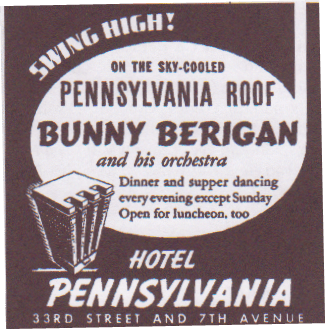
Recorded live in performance at the Roof Garden of Hotel Pennsylvania in New York on June 27, 1937.
Bunny Berigan, first and solo trumpet, directing: Steve Lipkins and Irving Goodman, trumpets; Sonny Lee and Al George, trombones; Sid Perlmutter, first alto saxophone; Joe Dixon, alto saxophone and B-flat clarinet; Georgie Auld and Clyde Rounds, tenor saxophones; Joe Lippman, piano; Tommy Morganelli, guitar; Arnold Fishkind, bass; George Wettling, drums.
The story:
No one was more favorably impressed by Bunny Berigan’s trumpet artistry than fellow trumpeters Irving Goodman and Steve Lipkins, who were members of Berigan’s band as it was developing through the spring and into the summer of 1937. Here is a recollection by Irving:


“Steve and I would sit there in the back row, night after night, set after set and watch and listen to Bunny and be totally amazed at what he could and would do. I think most jazz musicians could appreciate Bunny’s improvisations and many of the things he did, but I think you have to be another trumpet player to really, totally, understand and appreciate what Bunny was able to do on the trumpet. Oh, Bunny had his off nights and on occasion he was less than inspired, but even then his playing was far above many of us. Steve was a fine lead player; I was a less than average soloist. But night after night Steve and I would look at each other often with a nod or a raised eyebrow, etc. in acknowledgment of what we’d just heard Bunny do. Playing the trumpet is damn hard work and Bunny would often make it seem so easy! But Steve and I knew how hard it was. Bunny, being able to drink as he did and still play, was even more amazing to us. Sonny Lee in our band had played with many of the greats including Bix. He told Steve and me on a number of occasions how great Bunny really was. I know Muggsy (Spanier) told Ralph Muzzillo, another very fine lead trumpet player, how much he admired Bunny’s playing. We all did!“(1)
Bunny Berigan and His Orchestra opened at the Madhattan Room of Hotel Pennsylvania on April 29, 1937. They remained there until June 1, when they moved to the roof garden atop the hotel, where they remained through June and into July.

The Berigan band was in the Victor studios on June 25. Joe Lippman, the band’s pianist, was by then very busy writing arrangements for them, and Joe Bushkin frequently subbed for him on piano during the band’s stay at the Pennsylvania Roof so that Lippman could devote more time to writing arrangements. In addition, Bunny began ordering more arrangements from Dick Rose and possibly Fred Norman, who played trombone in the Claude Hopkins band. Four sides were recorded on June 25, two evanescent pop tune vocals (“Roses in December” and “Mother Goose”), and two instrumentals: “Frankie and Johnnie”(2) (three takes) and “Mahogany Hall Stomp” (one take). Both of these were probably arranged by Dick Rose, though it is possible that Van Alexander arranged “Mahogany Hall Stomp.” These last two titles also quickly became a part of the Berigan canon, and were frequently played by his band. Bunny’s recordings of them began to sell in greater numbers than most of the pop tunes the band recorded.
Although Bunny had been making personnel changes for the previous several months and had greatly strengthened his band as a result, he was still not completely satisfied. His fixation on the first alto saxophone chair resulted in yet another change there. Sid Perlmutter, who undoubtedly was a fine musician, but a bit too stiff in his phrasing to please Bunny, was replaced at the end of the engagement at the Penn by yet another veteran dance band musician, the rotund Robert “Mike” Doty. Doty (1910–?) was one of the leading first alto players then on the big band scene. He had worked with Gene Kardos, Joe Haymes, Phil Harris, Ray Noble, and Tommy Dorsey before joining Berigan.


Bunny also replaced the young but extremely capable bassist Arnold Fishkind with another veteran, the powerful and dynamic Hank Wayland (1906–?). Like Mike Doty and Sonny Lee, Wayland had worked with many top bands (including Benny Goodman’s before Benny hired his bass-playing brother Harry), and was much respected by his peers. The second trombone chair was also changed with Morey Samel giving way to Al George. By the time the Berigan band left Hotel Pennsylvania, the personnel had finally arrived at a point where Bunny was satisfied. This Berigan band would continue to operate with only one or two changes through the next nine months.
At about this same time, Mort Davis was replaced as the band’s road manager by saxophonist Jack Stacy’s brother George Stacy.
It appears that the band’s day off at the Penn was Sunday, so on Sundays throughout the band’s residency there, after they finished their Mutual network Fun in Swingtime radio show at 7:00 p.m., they hurried to whatever one-nighters Rockwell-O’Keefe (or MCA-see below) had booked for them within a one-hour drive from New York.


It is strange that the White materials do not contain any information about one of the most momentous changes that occurred during this time involving the Berigan band—its move from the Rockwell-O’Keefe booking agency to Music Corporation of America. There is no doubt that MCA was the biggest and strongest band-booking agency in the country then, by far. Why had MCA so suddenly taken over booking the Berigan band in the middle of Bunny’s “buildup”? The only information I have found on this development is in Bob Inman’s Swing Era Scrapbook. The reference there is under the date Wednesday, June 23, 1937. After Inman and his buddies had visited the New York office of MCA to get pictures of Peg La Centra and Edythe Wright (adolescent boys!), they “…then walked down to Rockefeller Center where we met Vincent Prior at Rockwell-O’Keefe. He certainly is a swell guy. When I asked why Rockwell-O’Keefe had dropped managing Bunny Berigan’s new band, he told us that the band was always ‘getting drunk’ so they let MCA take over the band.”(3) How magnanimous of Rockwell-O’Keefe to unload this bunch of drunkards on poor, unsuspecting MCA!
I am rather dubious about the reason for this change given by Vincent Prior. While Bunny’s drinking was a fact beyond dispute, and while it is likely that Rockwell-O’Keefe probably told him from the beginning that he would have to control it to be a successful bandleader, drinking by bandleaders or indeed by entire bands in the swing era was hardly unusual. One of Rockwell-O’Keefe’s most successful bands, Casa Loma, was one of the boozingest bands in the business, and one of the most profitable. (The Casa Loma band practically lived on the road.) Also, there is no evidence of Bunny’s drinking (or that of his band) creating any problems for the Rockwell office during the time they were in an agency-client relationship.


My informed speculation on this development focuses instead on the relationships of Benny Goodman and Tommy Dorsey, especially Dorsey’s, with MCA. I have no hard evidence of this, but I suspect that BG and TD, by then MCA’s biggest swing stars, realized that if the Berigan band were also with MCA, it would benefit them in that MCA could use the Berigan band as a substitute for their bands when the need arose, and not disappoint promoters who had contracted for a hot swing band. Also, as the live performance of “Louise” presented here demonstrates, by June of 1937, Bunny Berigan’s band was very good, and Bunny himself was playing superbly. I’m sure MCA noticed.
Berigan signed with MCA in June of 1937. For the next five years, his professional life was esentially governed by MCA. Indeed, after his death in June of 1942, there continued to be dealings involving his various contractual obligations with MCA. It can be said without exaggeration that the story of Bunny Berigan as a bandleader from June of 1937 was inextricably intertwined with MCA.
Shortly after Bunny went to MCA, this item appeared in Tempo:
“Tommy Dorsey and Benny Goodman helped Bunny Berigan, heard on Mutual’s Fun in Swingtime program. ‘I’d still be putting out hot licks on an old beat-up trumpet if it weren’t for them,’ said Bunny, who was playing his trumpet in a hot five at a Fifty-second Street restaurant before they persuaded him to try for a sponsored radio show. ‘Goodman persuaded me to take a crack at radio. I did, and I clicked.’ Then he got a band together, borrowed some of Tommy Dorsey’s arrangements and began to play outside engagements, principally at colleges. Soon after, he signed for the present Tim and Irene commercial. ‘Benny’s interest in me continued,’ said Bunny, ‘even though I began to be a serious competitor. When he decided to go to Hollywood, he recommended that my band follow him at the Pennsylvania Hotel.’ Bunny considered following Goodman at the Hotel Pennsylvania to be one of his toughest jobs. He made good and went into the Roof for the spring season and on July 8 he moved into the Pavilion Royal.”(4)


What this article (MCA press-agentry?) does not relate is anything about the ongoing relationship between Bunny Berigan and Tommy Dorsey. Yes, Bunny was taking musicians from Tommy, and yes, his band was becoming in some ways a “competitor” for TD. But I doubt that Tommy ever felt threatened by Bunny’s band, or the success he would have with it. Tommy Dorsey was a man of extremes. He hated and he loved with equal passion. What is really interesting about Tommy is that he frequently hated and loved the same person with equal passion. This was the case with his brother Jimmy, and, I think, at least on occasion, with Bunny Berigan. (He had similar feelings later for Frank Sinatra and Buddy Rich, though with those two he had more admiration for their talent than love for them. He could, on occasion, hate them quite intensely though.) He had boundless admiration for Bunny’s musical talent and ability as a jazz soloist. He enjoyed Bunny’s easygoing personality and genial company. Yet he detested what Bunny was doing to his musical talent as a result of his ever-increasing intake of alcohol. I think that Tommy Dorsey, who successfully battled the bottle himself, discussed Bunny’s drinking with him on many occasions, and warned him that drinking and bandleading made a bad combination. I am also reasonably certain that Bunny listened and agreed, over and over again. The tragedy is that Bunny Berigan’s addiction to alcohol by 1937 was so profound that he could not stop drinking on his own. He had tried many times, and when he did reduce his intake of alcohol, his friends and coworkers rejoiced because they could see how much better he was able to play the trumpet.


I also think that Tommy Dorsey wanted Bunny to be able to benefit from the superior agency relationship MCA could provide for him and his band, and did whatever he could to move Bunny from Rockwell-O’Keefe to MCA. The obligatory lecture on drinking undoubtedly came from MCA as it had from Rockwell-O’Keefe, when Bunny signed with MCA. Everyone involved hoped it would help him. Nevertheless, as I have suggested, there also had to be something in this deal for Tommy. Indeed Tommy may have either loaned Bunny some money to keep his band going during the 1937 buildup (“Marie” by then had become something of an annuity for TD), or intervened with MCA or someone else (5) to do this. Whatever backstage maneuvering really occurred, Bunny’s move to MCA in June of 1937 was definitely a move up.


The music:
By the time this off-the-air recording of “Louise” was made at the end of June in 1937, Bunny Berigan and his band had been ensconced at Hotel Pennsylvania for two months. That engagement, which would soon end, had provided Berigan with much positive advertising for his band as a result of their very frequent sustaining (unsponsored) radio broadcasts from that venue. Although the Berigan band was also making a few records for Victor at this same time, their major source of income was the sponsored weekly Mutual Radio Network show they broadcast each Sunday evening. Musically, Bunny had used this time to gradually strengthen his band.
The arrangement we hear in this performance bears a surface resemblance to many antiphonal/call-and-response arrangements then in the book of Benny Goodman’s band, at least through the first chorus. During that first chorus, Berigan’s electric presence on first trumpet is apparent.
The young tenor saxophonist Georgie Auld takes a rhythmic sixteen-bar jazz solo, backed by the equally rhythmic brass, to open the second chorus. This is followed by eight-bar solos by Joe Dixon on clarinet, and the newly arrived Sonny Lee on trombone.


A brief transitional passage opens the way for Berigan’s three eight-bar improvisations. The first eight consist of Bunny entering in his high register and working his way down; the second eight follows a similar patters, but of course the notes played in each tract are entirely different. They are played with a full, rich trumpet sound no matter what the register, and strong swing. The third eight bars bristle with an intensely rhythmic explosion of high notes.
The out-chorus is a joyous ensemble romp topped by the unmistakable sound of Bunny on first trumpet.
At this moment in time, Bunny Berigan was as happy as he ever was in his short life. His exuberant playing on this recording reflects that.
“Louise” is a song that was written by Leo Robin and Richard Whiting for the film Innocents of Paris, in which it was introduced by Maurice Chevalier, who soon thereafter recorded it. The song was then essentially associated with Chevalier, though widely performed and recorded by other artists, including jazz musicians, who found it to offer chord changes that facilitated improvisation. Bing Crosby, at the beginning of his ascent as the premier male vocalist of the 1930s, recorded “Louise” with Paul Whiteman’s orchestra on March 15, 1929. Crosby also recorded a comedy version of the song with the Rhythm Boys on April 10, 1929. Benny Goodman’s recording of it, made in late 1938, includes several fine jazz solos by BG, Ziggy Elman, Jess Stacy and Jerry Jerome. In the classic 1945 film The Lost Weekend, “Louise” is played on piano and sung by Harry Barris (one of the Rhythm Boys) in a scene at Harry and Joe’s tavern. (6)
The recording presented with this post was digitally remastered by Mike Zirpolo.
(1) White materials: June 18, 1937.
(2) “Frankie and Johnnie” is how the title of this tune appears on the label of Victor 25616-A
(3) Swing Era Scrapbook: 192.
(4) Tempo: August 1937, cited in the White materials: July 11, 1937.
(5) The “someone else” who could have loaned money to Bunny Berigan at the time MCA began to represent him was attorney John Gluskin. Gluskin had played some role in Tommy Dorsey’s early career as a bandleader, and was described by some of the musicians in Berigan’s band at the time as “a money man.” In addition, Berigan may have signed a contract with John Gluskin to act as his personal manager in late 1938 or early 1939, after he came to an acrimonious parting of the ways with his first manager, Arthur Michaud.
(6) The information included in this post about the song “Louise” is derived from the Wikipedia post on it.